Well packaged. Excellent quality



$75.00
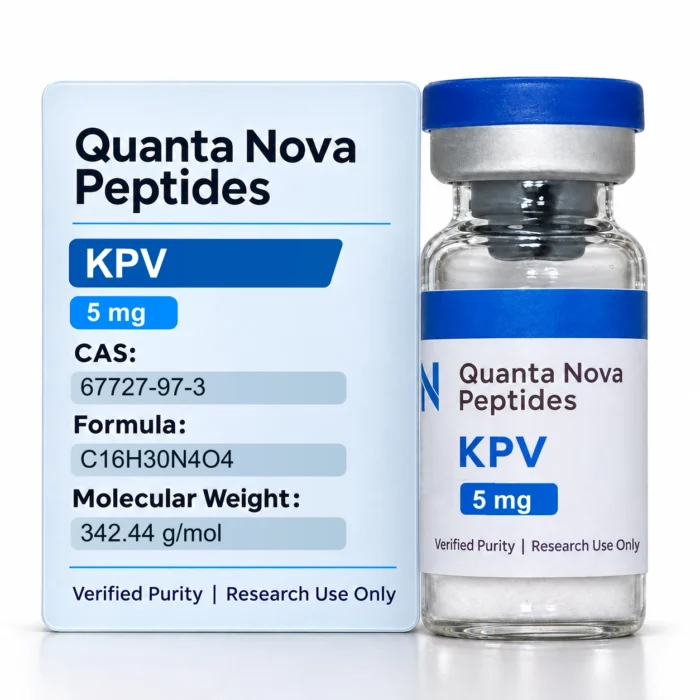
KPV is a tiny three-amino-acid peptide (Lys-Pro-Val), the tail end of the natural hormone alpha-MSH. Its small size and simple structure have made it a popular tool in inflammatory-signaling (NF-κB) research.
For Laboratory Research Use Only · Not for Human Use
Certificate of Analysis
This batch has been independently tested, verified, and documentation is available for review.
Want to combine KPV with other peptides? Build your own 4-pack or 8-pack peptide bundle and choose any mix of separate vials.
Quanta Nova KPV peptide is supplied as four 5 mg vials of lyophilized powder, 20 mg in total, lyophilized in-house by Quantum Innovation Labs in Garland, Texas. KPV is the tripeptide Lys-Pro-Val, the C-terminal fragment of alpha-melanocyte-stimulating hormone (α-MSH 11–13), sold here strictly as a research compound for in-vitro and laboratory use.
Each batch is prepared with Type I ultrapure water, filtered through a 0.22 µm PES membrane and filled into sterilized Type I borosilicate glass vials. Vials are pre-frozen at −85 °C to rapidly lock in delicate structures, then lyophilized with an annealing step and a final drying stage to remove residual moisture. The finished product is released only after independent testing by an ISO/IEC 17025-accredited laboratory.
| Parameter | Specification |
|---|---|
| Compound | KPV |
| Also known as | Lys-Pro-Val; α-MSH (11-13); ACTH (11-13) |
| Sequence | Lys-Pro-Val (KPV), 3 residues |
| Molecular formula | C16H30N4O4 |
| Molecular weight | 342.4 g/mol |
| CAS number | 67727-97-3 |
| PubChem CID | 125672 |
| UNII | 7V6LGD8S5R |
| Form | Lyophilized powder |
| Contents | 4 vials × 5 mg (nominal), 20 mg total |
| Storage | −20 °C, protected from light |
Every batch of KPV is independently tested by a third-party ISO/IEC 17025-accredited laboratory in the United States, for:
Results for the batch currently shipping are shown in the COA Report section on this page and update automatically when a new batch is released. You can also search any batch on our COA Reports page and confirm it directly with the testing laboratory using the verification link.
In our dissolution observations, KPV dissolved clear in bacteriostatic water, with no cloudiness or gelling, and the research we reviewed showed no evidence of BAC-water-related degradation. See the KPV entry in our BAC Water for Peptides Compatibility Checklist.
| Total diluent added to one 5 mg vial | Calculated concentration (nominal 5 mg) |
|---|---|
| 1.0 mL | 5 mg/mL |
| 2.0 mL | 2.5 mg/mL |
| 2.5 mL | 2 mg/mL |
| 5.0 mL | 1 mg/mL |
Concentrations are calculated from the nominal 5 mg; the measured quantity for the current batch is on the COA. A clear solution shows complete dissolution, not peptide integrity. Follow the diluent and volume your protocol specifies.
KPV was identified as a COOH-terminal fragment of α-MSH in the late 1980s. Most published work comes from cell-culture and animal models. Key references include:
KPV is not approved by the FDA or any other drug regulatory agency, and no human clinical trials have established its effects. These references describe published research only. They are not claims about this product, which is supplied for laboratory research use only.
KPV is a synthetic tripeptide, Lys-Pro-Val, the three amino acids at the C-terminal end of alpha-melanocyte-stimulating hormone (α-MSH 11–13). Quanta Nova supplies it as a lyophilized research compound.
KPV is the one-letter code for its three amino acids: K (lysine), P (proline) and V (valine). It is also listed as α-MSH (11-13) or ACTH (11-13).
In cell-culture and animal studies, KPV has been examined for its effects on inflammatory signaling, including the NF-κB and MAP kinase pathways, and it is taken up by intestinal cells through the PepT1 transporter. These are laboratory findings. Quanta Nova makes no claims about effects in humans or animals.
KPV is used as a research tool in cell-culture and animal models, including intestinal epithelial cell research, inflammatory-signaling studies and work on peptide transport.
α-MSH is a 13-amino-acid peptide hormone. KPV is its last three residues (positions 11–13). Research has examined how much of α-MSH’s activity in lab models can be attributed to this C-terminal fragment.
No. FDA’s May 2026 briefing document states that KPV is not a component of any FDA-approved drug. In July 2026 an FDA advisory committee voted 8–6 to recommend adding KPV to the list of bulk substances pharmacies may use in compounding, against the recommendation of FDA’s own review team. That vote is not binding, requires formal rulemaking, and did not change KPV’s regulatory status. Quanta Nova supplies KPV for laboratory research use only, not for human use.
They are unrelated molecules. KPV is a 3-amino-acid fragment of α-MSH. BPC-157 is a 15-amino-acid partial sequence of a protein found in gastric juice. Quanta Nova sells both as lyophilized research peptides.
Quanta Nova sells KPV 5 mg as a 4-vial lyophilized pack, lyophilized in Garland, Texas. Whoever you buy from, look for a batch-specific certificate of analysis from an accredited third-party lab that covers identity, purity, quantity and endotoxins, and that you can verify with the lab yourself.
In our dissolution observations, KPV dissolved clear in bacteriostatic water with no cloudiness or gelling. With a nominal 5 mg vial, 1 mL gives 5 mg/mL, 2 mL gives 2.5 mg/mL, 2.5 mL gives 2 mg/mL and 5 mL gives 1 mg/mL. Follow the diluent and volume your protocol specifies.
Four vials, each containing 5 mg (nominal) of lyophilized KPV, 20 mg in total. Bacteriostatic water is not included; it is sold separately.
The COA for the batch currently shipping is shown on this page. Every batch is tested by an ISO/IEC 17025-accredited laboratory for identity, purity, quantity and endotoxins. Match the batch number on your vial to our COA Reports page and use the verification link to confirm the results with the lab.
Lyophilized: −20 °C, protected from light and moisture. After reconstitution: 2–8 °C and use promptly.
Orders ship the next business day. Eligible U.S. orders get free ground shipping (the cart shows whether your order qualifies), and we also ship internationally.
Yes. 2–3 packs save 10%, 4–7 packs save 20%, and 8 or more save 30%. You can also build your own 4- or 8-vial variety pack from any of our lyophilized peptides.
This product is sold for laboratory and in-vitro research. It is not a drug, food, cosmetic or dietary supplement and is not for human or veterinary use.
BPC-157 5 mg · TB-500 10 mg · Melanotan II 10 mg · LL-37 5 mg · DSIP 5 mg · Bacteriostatic Water · COA Reports
Disclaimer: For research use only.