Resources / Peptide guide
Three amino acids. One copper ion. So what is GHK-Cu? Its distinctive blue color is the visible part of a much more interesting chemistry story: how a small peptide binds copper, and why researchers study the complex.
What is GHK-Cu? GHK-Cu is the copper(II) complex of the tripeptide glycine–histidine–lysine. Researchers study its copper-binding chemistry and its behavior in cell and animal models. It is also known in cosmetic ingredient terminology as copper tripeptide-1. Research findings depend on the compound, formulation and experimental conditions. [2] [7] [9]
Prepared by Quanta Nova LLC · Technical review by Isaiah D., Chief Technology Officer and Head of Formulations, Quantum Innovation Labs LLC.
Updated October 24, 2026 · Laboratory research reference
The copper peptide, explained
A small complex.A substantial research history.
Understand the molecule, distinguish GHK from GHK-Cu, and read the evidence in context.
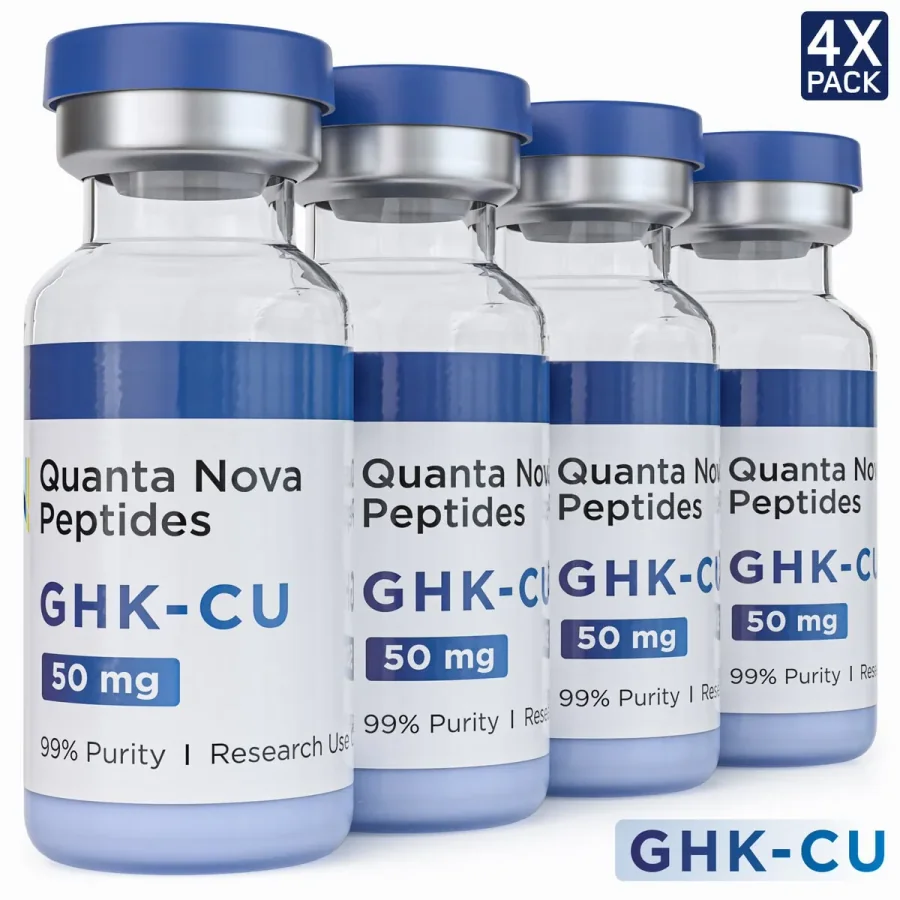
Quanta Nova product artwork, shown for product identification.
In this guide
Chemical identity
GHK-Cu at a glance
| Full name | Glycyl-L-histidyl-L-lysine copper(II) complex |
|---|---|
| Sequence | Gly–His–Lys · Cu(II) |
| Formula | C14H22CuN6O4 |
| Molecular weight | 401.91 g/mol |
| CAS number | 89030-95-5 |
| PubChem CID | 10111685 |
| Appearance | Blue to blue-violet material; blue in solution |
| Solubility | Water-soluble; verify conditions for the specific material and method |
Reference identifiers describe the copper complex, not GHK alone. [9] [10]
What does GHK-Cu stand for?
G is glycine, H is histidine and K is lysine. These three amino acids form GHK. Cu is the chemical symbol for copper.
The distinction matters when comparing papers and certificates. GHK is the parent peptide, with a molecular weight of 340.38 g/mol. GHK-Cu contains bound copper and has a molecular weight of 401.91 g/mol. A study of GHK does not automatically establish the same result for GHK-Cu or for a finished formulation. [2] [6] [9]
“Copper peptide” describes a class of complexes; GHK-Cu is one specific member. Check the full identity rather than relying on the general term.
Where does GHK-Cu come from?
The research history begins with GHK isolated from human serum by Loren Pickart and M. Michael Thaler, reported in 1973. Its interaction with copper became an important subject of later research. [1] [2]
GHK also occurs naturally in the body. A widely cited review reports plasma levels of about 200 ng/mL at age 20, declining to about 80 ng/mL by age 60, one reason the peptide has drawn so much research interest.[7]
Natural occurrence and commercial manufacture are different questions. Quanta Nova supplies GHK-Cu as lyophilized research material; its product specifications and current batch documentation are available on the GHK-Cu product page.
Inside the complex
How GHK binds copper, and why it is blue
GHK provides three nitrogen donors around copper(II): its N-terminal amine, a deprotonated peptide-bond nitrogen, and a nitrogen in histidine’s imidazole ring. Another ligand can occupy a further coordination position. The species present depend on conditions such as pH and other molecules in the solution. [2]
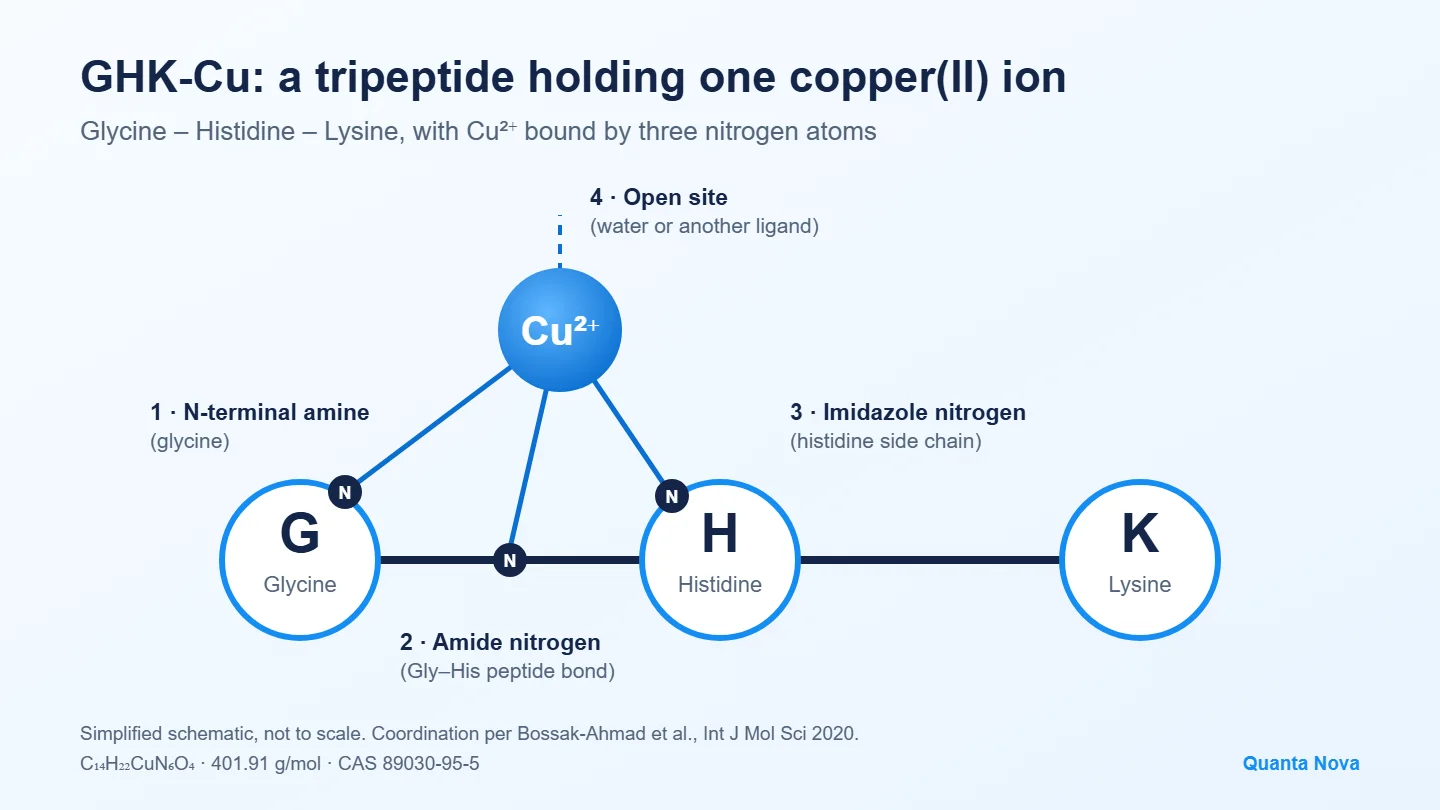
The copper complex absorbs visible light, producing its characteristic blue appearance. The blue color is useful context, but it is not a purity test. Concentration and solution chemistry can change its appearance; analytical evidence is needed to assess identity and stability. [2]
Evidence in context
What does GHK-Cu do? Benefits researchers are studying
Research into GHK-Cu benefits spans several kinds of evidence. A cell experiment, an animal model and a finished cosmetic study answer different questions. The examples below identify what was tested and where interpretation should stop.
In short: in laboratory and animal studies, GHK-Cu has been studied for effects on skin-structure proteins such as collagen, on wound and tissue repair, on inflammatory and oxidative-stress signals, and on gene activity. Human evidence is limited to small topical cosmetic studies, and GHK-Cu has no approved medical use.
Fibroblasts and skin structure
- What was studied
- Normal and previously irradiated human dermal fibroblasts grown in laboratory media.
- What researchers observed
- Pollard and colleagues reported faster cell growth and early changes in growth-factor production following GHK-Cu exposure. [3]
- What it does not establish
- A response in cultured cells does not establish clinical efficacy or validate a commercial research material.
Wound repair and tissue remodeling
- What was studied
- An ischemic wound model in rats, comparing a topical tripeptide-copper gel with its vehicle and an untreated control.
- What researchers observed
- The treated group showed greater wound-area reduction than untreated controls, alongside changes in inflammatory and matrix-remodeling markers. [4]
- What it does not establish
- The findings concern that animal model and gel formulation; they do not establish human efficacy.
Inflammation and oxidative stress
- What was studied
- Macrophage cultures and a mouse model of experimentally induced acute lung injury.
- What researchers observed
- Park and colleagues observed reduced oxidative-stress and inflammatory readouts under the tested conditions. [5]
- What it does not establish
- These are preclinical measurements, not evidence that GHK-Cu treats a lung condition in people.
Gene expression and collagen remodeling
- What was studied
- Gene-expression datasets and human lung fibroblasts, including cells derived from people with COPD.
- What researchers observed
- Campbell and colleagues identified GHK through computational screening and observed changes in gene expression and collagen-gel remodeling in cultured cells. [6]
- What it does not establish
- This study examined GHK; it does not establish clinical efficacy or validate a finished GHK-Cu formulation.
Topical cosmetic research
- What was studied
- GHK-Cu-containing cosmetic formulations summarized in a published review.
- What researchers observed
- The review describes small studies reporting changes in skin appearance. Their formulations and study designs differ. [7]
- What it does not establish
- Topical cosmetic findings cannot establish the effects or safety of research powder used by another route.
Hair follicles, blood vessels and nerves
- What was studied
- Laboratory and animal findings discussed in the wider GHK literature.
- What researchers observed
- A review describes hair-follicle observations and vessel or nerve outgrowth in selected models. [7]
- What it does not establish
- These are distinct research questions with different compounds and methods, rather than established human benefits.
Reading the evidence: These studies explain the scientific interest in GHK and GHK-Cu. They do not validate Quanta Nova’s product as a treatment. Results from different compounds, formulations and routes should remain separate, and a review is a summary of evidence rather than an additional independent experiment.
U.S. regulatory context
Is GHK-Cu FDA approved?
GHK-Cu is not an FDA-approved drug. Its appearance in cosmetic products should not be confused with approval as a medicine.
The FDA has also reviewed GHK-Cu in the context of pharmacy compounding and notes that human safety data are limited.[8]
Quanta Nova GHK-Cu is supplied for laboratory research only. This guide does not establish suitability for human use or provide dosing or administration instructions.
From literature to laboratory
Research-grade GHK-Cu: what to check
A published paper cannot verify the contents of a particular vial. Before selecting research material, match the documentation to the product and batch.
- Identity: confirm that the material is the copper complex, with the stated sequence and form.
- Purity and method: read the chromatographic result together with the method and report scope.
- Quantity: distinguish measured content per vial from chromatographic purity.
- Assay suitability: check relevant specifications, including endotoxins where they matter to the experiment. An endotoxin result is not a sterility test.
- Traceability: match the vial’s lot to its COA and the laboratory’s verification record.
- Storage: follow the specific product instructions. Quanta Nova specifies −20 °C, dry and protected from light, for its lyophilized GHK-Cu.
Quanta Nova’s product page displays the current batch COA and its Vanguard verification link. Supplier storage and solubility references are useful context, but they are not stability testing of a Quanta Nova solution. [9]
Frequently asked questions
Does GHK-Cu need to be refrigerated?
Quanta Nova’s product instructions specify −20 °C storage for the lyophilized powder, kept dry and protected from light. Prepared solutions need their own storage and stability assessment. Follow the product instructions and your validated laboratory protocol; a BAC-water vial’s after-access limit does not establish the lifetime of a peptide mixture. Read the GHK-Cu storage instructions.
Can GHK-Cu dissolve in BAC water?
Quanta Nova reports clear dissolution of its GHK-Cu in BAC water, without observed cloudiness or gelling. That is an appearance observation, not analytical proof of retained integrity over time. Published supplier data document water solubility separately. [9] See the GHK-Cu compatibility assessment.
Does the blue color prove GHK-Cu purity?
No. Color is consistent with the copper complex, but it cannot identify every impurity, measure content per vial or establish stability. Check batch-matched analytical results. A clear appearance also does not prove sterility or preserved peptide integrity.
Is research-grade GHK-Cu the same as a cosmetic serum?
No. A research powder and a finished cosmetic are different products. A cosmetic includes a complete formulation and its own intended use, concentration, packaging and safety assessment. Results from a particular serum or cream should not be transferred to a research vial.
Is GHK-Cu safe for human use?
Limited human data do not establish safety across routes, formulations or uses, and the FDA notes that human data on GHK-Cu are limited. Quanta Nova GHK-Cu is supplied for laboratory research only.[8]
Is GHK-Cu FDA approved?
No. GHK-Cu is not approved by the FDA as a drug. It appears in cosmetics as copper tripeptide-1, and research-grade material is sold for laboratory use.
What is the difference between GHK and GHK-Cu?
GHK is the tripeptide glycine–histidine–lysine on its own (340.38 g/mol, CAS 49557-75-7). GHK-Cu is the same peptide bound to one copper(II) ion (401.91 g/mol, CAS 89030-95-5); the copper is what makes it blue.
What is GHK-Cu used for?
Mainly laboratory research, including copper chemistry and cell and animal models of skin structure, tissue repair and gene expression, and, as copper tripeptide-1, cosmetic skin and hair products. It has no approved medical use.
Is GHK-Cu natural or synthetic?
Both, in a sense. GHK occurs naturally in human plasma, while research-grade GHK-Cu is made synthetically: the peptide is assembled from its amino acids, complexed with copper, purified and freeze-dried.
Is GHK-Cu legal?
In the United States, GHK-Cu is not a controlled substance, and research-grade material is sold for laboratory use. Rules vary by country and intended use, so check the regulations that apply to you. This is general information, not legal advice.
Sources and research references
Numbered citations distinguish primary studies, review summaries, regulatory information and supplier documentation. Research findings concern the materials and conditions described in each source.
- Pickart L, Thaler MM. Tripeptide in human serum which prolongs survival of normal liver cells and stimulates growth in neoplastic liver. Nature New Biology. 1973;243:85–87.Original discovery paper.
- Bossak-Ahmad K, et al. Ternary Cu(II) complex with GHK peptide and cis-urocanic acid as a potential physiologically functional copper chelate. International Journal of Molecular Sciences. 2020;21:6190.Primary coordination-chemistry study.
- Pollard JD, et al. Effects of copper tripeptide on the growth and expression of growth factors by normal and irradiated fibroblasts. Archives of Facial Plastic Surgery. 2005;7:27–31.Primary cell-culture study.
- Canapp SO Jr, et al. The effect of topical tripeptide-copper complex on healing of ischemic open wounds. Veterinary Surgery. 2003;32:515–523.Primary animal study; tested topical formulation.
- Park JR, et al. The tri-peptide GHK-Cu complex ameliorates lipopolysaccharide-induced acute lung injury in mice. Oncotarget. 2016;7:58405–58417.Primary cell and animal study.
- Campbell JD, et al. A gene expression signature of emphysema-related lung destruction and its reversal by the tripeptide GHK. Genome Medicine. 2012;4:67.Primary computational and cell study; GHK, not a finished GHK-Cu product.
- Pickart L, Margolina A. Regenerative and protective actions of the GHK-Cu peptide in the light of the new gene data. International Journal of Molecular Sciences. 2018;19:1987.Review; includes topical cosmetic reports and exploratory findings.
- U.S. Food and Drug Administration. Certain bulk drug substances for use in compounding that may present significant safety risks.Regulatory source; GHK-Cu entry applies to injectable routes.
- MedChemExpress. Copper tripeptide (HY-P0063) product data sheet.Third-party supplier reference for identifiers, water solubility and storage; not Quanta Nova stability testing.
- National Library of Medicine. PubChem compound summary, CID 10111685.Chemical identifiers.
For laboratory research only. Quanta Nova GHK-Cu is not intended for human consumption or administration and is not supplied as a drug, cosmetic or dietary supplement. This educational guide does not provide medical advice or instructions for treating any condition.