Prepared by Quanta Nova LLC · Technical review by Isaiah D., Chief Technology Officer and Head of Formulations, Quantum Innovation Labs LLC.
Updated October 18, 2026
The main difference is the preservative. Choosing a laboratory diluent also requires checking the specific product label and the research material’s instructions.
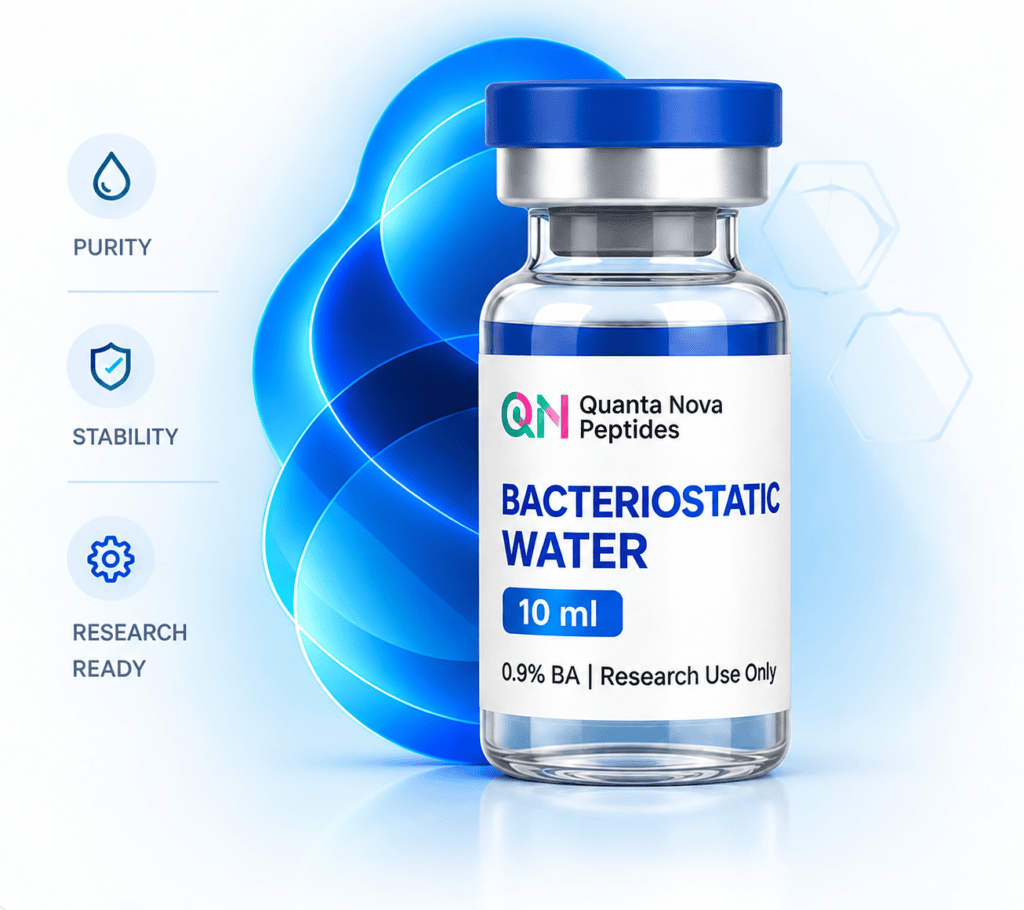
Bacteriostatic water contains a preservative; preservative-free sterile water does not. Quanta Nova BAC water contains 0.9% benzyl alcohol. That difference can matter to a research method, so the two should not be substituted solely because both are water-based.
What does “sterile water” mean in this comparison?
“Sterile water” can appear on products intended for different purposes. Read the full name and instructions. Here, the comparison is with preservative-free sterile water; the manufacturer’s Sterile Water for Injection, USP labeling provides a specific example with no antimicrobial preservative and single-dose directions.
That clinical product is a reference for understanding the label distinction. Quanta Nova BAC water is sold for laboratory research, not as a substitute for an injectable drug diluent.
| Feature | Quanta Nova BAC water | Preservative-free sterile water |
|---|---|---|
| Preservative | 0.9% benzyl alcohol | No antimicrobial preservative |
| Intended use | Laboratory research only | Depends on the exact labeled product |
| After access | QN recommends a maximum of 28 days or EXP, whichever is earlier | Follow its instructions; the cited Sterile Water for Injection label specifies single-dose use |
| Compatibility | Confirm that the material and method allow the formulation | Confirm the required grade and formulation |
| Storage | 20–25°C for the QN BAC-water vial | Follow the specific product label |
Does bacteriostatic mean sterile?
The terms describe different properties. “Bacteriostatic” refers to inhibiting bacterial growth. “Sterile” describes freedom from viable microorganisms. A preservative is not, by itself, proof of sterility, and it does not make contaminated water sterile.
A product may be both sterile and bacteriostatic. Assess the claim and the supporting evidence separately. The manufacturer’s description of Bacteriostatic Water for Injection, for example, identifies both the sterile preparation and its preservative.
Can you replace one with the other in a research protocol?
Only when the material’s documentation and the method support the change. A protocol calling for preservative-free water has not automatically allowed benzyl alcohol. Likewise, the lack of a preservative changes what must be checked about handling after access.
For peptides, the solvent decision also depends on the material’s properties. Thermo Fisher’s solubility guidance describes why the same water-based solvent will not suit every peptide. Use the material-specific instructions rather than a general “better for peptides” claim.
Can sterile water be kept for 28 days after opening?
Do not transfer a BAC-water recommendation to preservative-free sterile water. The cited Sterile Water for Injection label directs users to discard unused contents. Other laboratory water products must be handled according to their own instructions.
For QN BAC water, read the storage and first-access guidance. The limit applies to the BAC-water vial, not to the stability of another material after mixing.
What evidence should you check before choosing?
Confirm the full product name, ingredients, intended use and required quality specifications. Match the batch documentation to the vial and read which properties were tested. A pH or benzyl alcohol result should not be described as a sterility or endotoxin test.
If you are comparing labels that say “reconstitution solution,” check their actual composition too. That phrase alone does not establish a formula. See the full reconstitution solution vs BAC water comparison. For broader formulation background, see what bacteriostatic water is.
Quanta Nova BAC water is for laboratory research only, not human or animal use. This guide does not provide injection, dosing or administration instructions.
Sources
- Manufacturer labeling: Sterile Water for Injection, USP — preservative-free formulation and single-dose directions.
- Manufacturer labeling: Bacteriostatic Water for Injection, USP — sterile preparation and preservative description.
- Thermo Fisher Scientific: Peptide Design, solubility section — material-specific compatibility.
- Quanta Nova product and batch documentation — QN formulation, instructions and report scope.