Prepared by Quanta Nova LLC · Technical review by Isaiah D., Chief Technology Officer and Head of Formulations, Quantum Innovation Labs LLC.
Updated October 18, 2026
A bottle labeled “reconstitution solution” may contain bacteriostatic water. The name alone does not tell you its formula.
Reconstitution solution and bacteriostatic water are not automatically the same. Reconstitution describes preparing a material in solution. Bacteriostatic water identifies a water formulation containing a preservative that inhibits bacterial growth. Check the ingredients and the material’s instructions before treating two products as interchangeable.
What is reconstitution solution?
In laboratory work, reconstitution means adding an appropriate solvent or diluent to a dried material to prepare a solution. The liquid may be water, a buffer or another solvent specified for that material. “Reconstitution solution” therefore describes a purpose rather than one universal recipe.
Some suppliers use the term for BAC water. For example, G-Biosciences identifies its reconstitution solution as water containing 0.9% benzyl alcohol. That is the composition of that product, not a definition that applies to every bottle using the same name.
Compare BAC water with preservative-free sterile water.
How does bacteriostatic water differ?
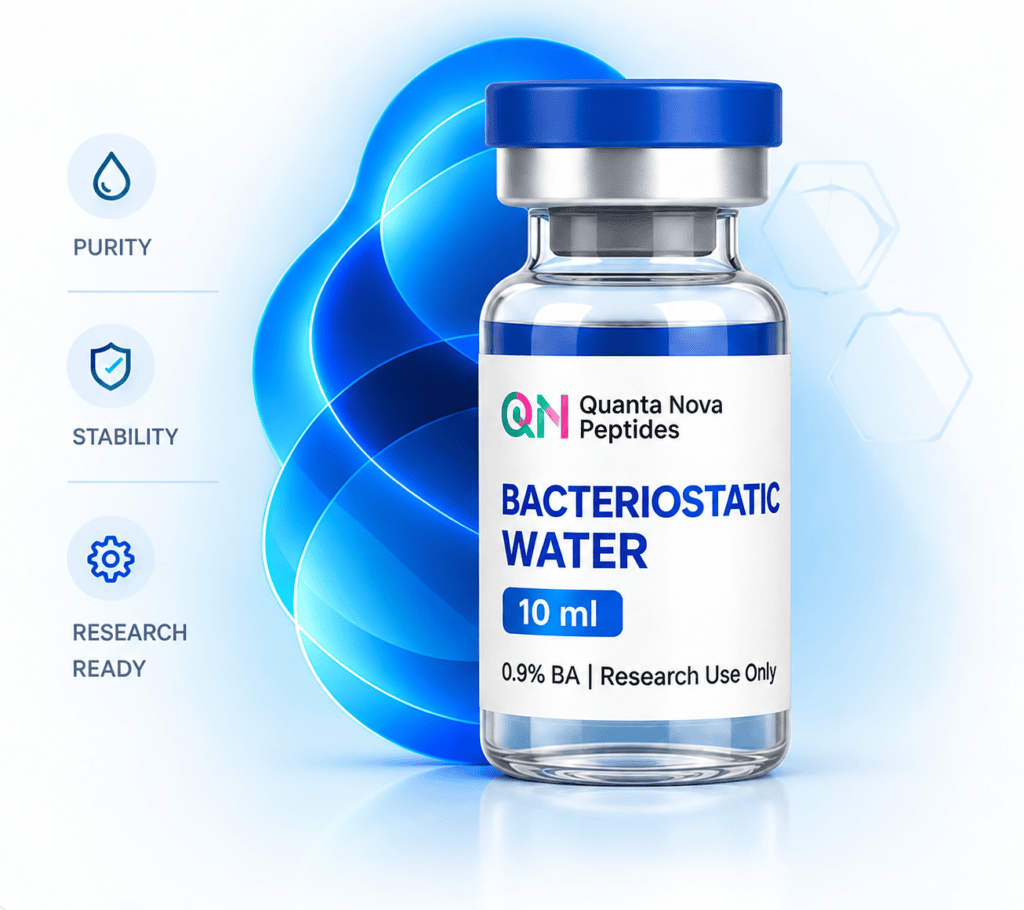
Quanta Nova BAC water contains 0.9% benzyl alcohol. The preservative is part of the formulation and must be considered when evaluating a research protocol. A preservative-free liquid is not the same formulation simply because both liquids are sold for reconstitution.
| What to compare | “Reconstitution solution” | Quanta Nova BAC water |
|---|---|---|
| Meaning of the name | Describes an intended preparation step | Identifies a BAC-water formulation |
| Ingredients | Check the specific product | Water with 0.9% benzyl alcohol |
| Preservative | May be present or absent | Benzyl alcohol |
| Suitable for every research material? | No; follow material-specific instructions | No; confirm compatibility |
| Evidence to inspect | Label, instructions and relevant test documentation | Label, instructions and applicable batch report |
How can you tell whether the two products match?
Compare the complete ingredient list and concentrations, rather than relying on the product title. Then check the intended use, storage directions and batch documentation. If the composition is unclear, ask the supplier before substituting it into a protocol.
Even a matching ingredient list does not establish identical quality specifications or suitability for an experiment. Check the properties that your method requires and whether they were actually assessed.
Is BAC water suitable for every peptide?
No. Solubility depends on the material and the conditions of the experiment. Thermo Fisher’s peptide-design guidance explains how amino acid composition affects solubility and why some peptides require other solvent conditions. A name such as “peptide reconstitution solution” does not resolve that question.
Start with the material’s own documentation. Our BAC water compatibility guide explains what to check without assuming one diluent works for every peptide.
What should the batch report show?
Check that the report identifies the relevant sample or batch, names the tests performed and gives their results. Where issuer verification is available, compare the report with the laboratory’s record. A report covering benzyl alcohol content and pH supports those measurements; it does not establish unreported sterility, endotoxin or mixture-stability results.
Quanta Nova’s BAC hub displays the current batch documentation and verification link. Read that report’s scope rather than assuming every possible quality test is included.
Does reconstitution solution follow the same storage rules?
Only if the supplier’s instructions say so. Quanta Nova’s BAC-water instructions should not be applied to an unidentified solution or to a material after mixing. See our BAC water storage and shelf-life guide for instructions specific to the QN vial.
Quanta Nova BAC water is for laboratory research only, not human or animal use. This guide does not provide injection, dosing or administration instructions.
Sources
- G-Biosciences: Reconstitution solution/Bacteriostatic water — a documented example of naming and formulation.
- Thermo Fisher Scientific: Peptide Design, solubility section — material-specific solvent compatibility.
- Quanta Nova batch documentation — product-specific test scope.