Five evidence-based checks for choosing BAC water for a research peptide—and knowing what a batch report can and cannot establish.
Prepared by Quanta Nova LLC · Technical review by Isaiah D., Chief Technology Officer and Head of Formulations, Quantum Innovation Labs LLC.
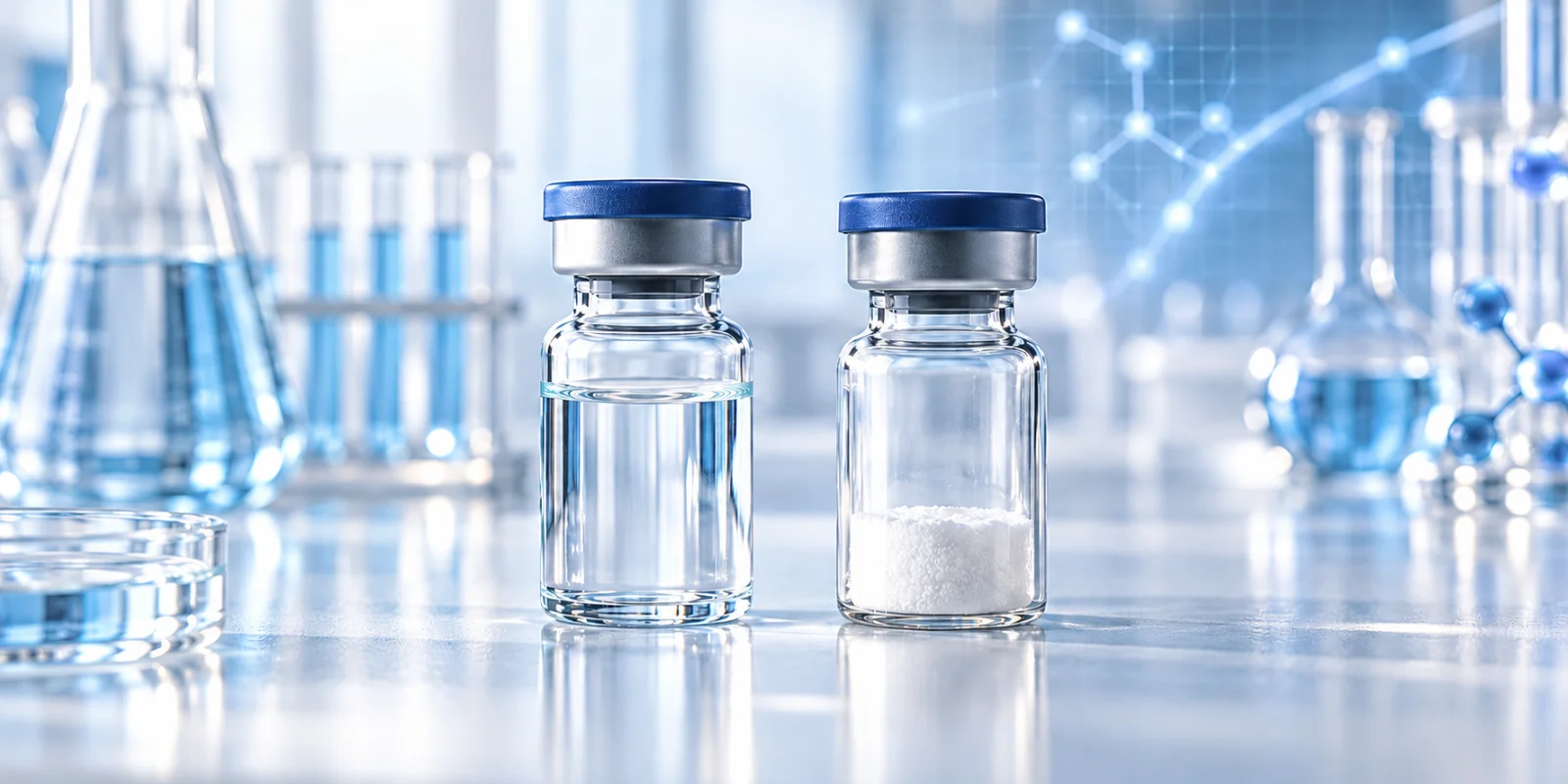
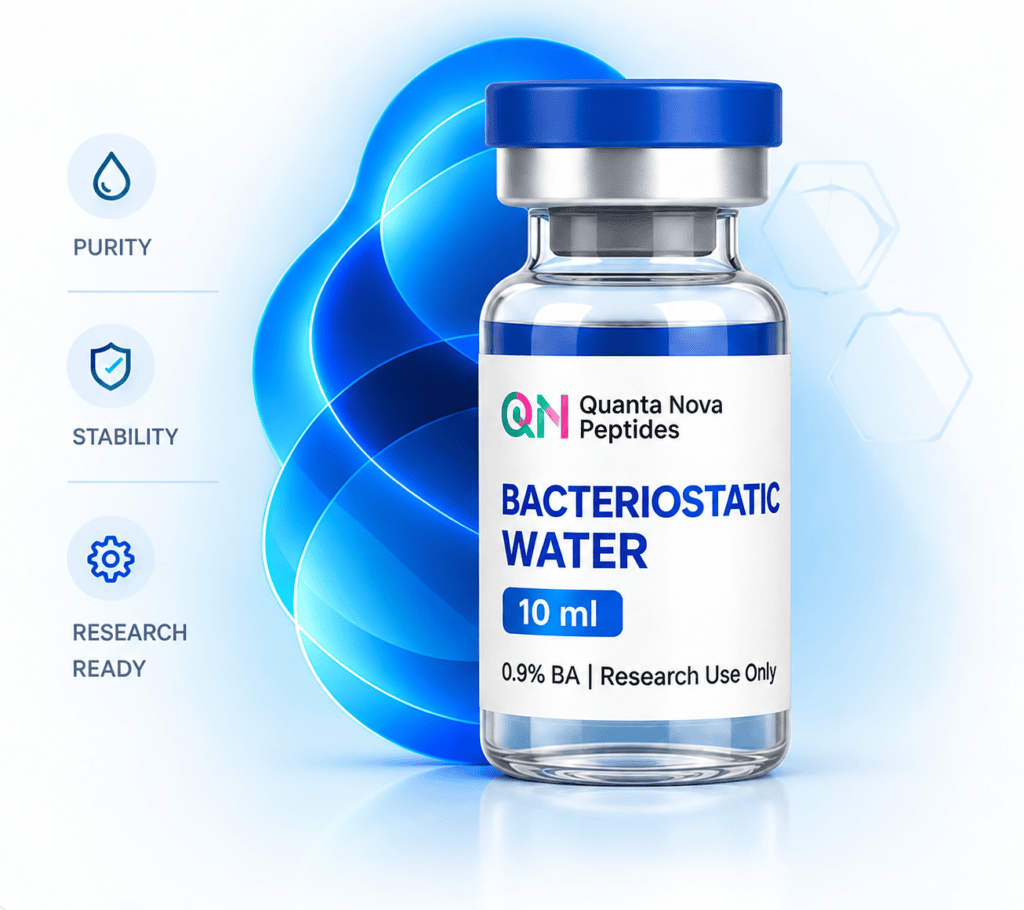
BAC water for peptides is a common pairing in research, but it isn’t automatically right for every peptide. Bacteriostatic water (BAC water) is water containing a preservative, typically 0.9% benzyl alcohol. Whether it suits a particular peptide depends on the peptide’s sequence and form, the intended concentration, and the full formulation.
Do not assume BAC water is compatible with all peptides. Before choosing it for a research peptide, verify compatibility using two sources: the peptide supplier’s documentation and the BAC water’s batch-specific test report. If the combination hasn’t been evaluated, compatibility is unknown.
The short answer
BAC water is not universally compatible with every peptide. Start with peptide-specific documentation, then verify the actual BAC water batch and the tests shown on its COA.
01 / Compatibility
Is BAC water suitable for every peptide?
No. No single diluent works equally well for every peptide, and the research on benzyl alcohol points in more than one direction.
Solubility depends on the peptide. Sigma-Aldrich’s peptide solubility guidelines explain that a peptide’s amino acid composition, especially its net charge and how hydrophobic it is, largely determines how well it dissolves in water. Some peptides aggregate or form a gel. The guidelines recommend testing a small portion before dissolving the whole sample, and choosing a solvent that suits both the peptide and the experiment.
Benzyl alcohol’s effect varies by molecule. Published formulation studies show both outcomes:
- In one study, benzyl alcohol increased the physical stability and solubility of a 31-amino-acid peptide under salt stress, but the same trends did not hold for two structurally similar peptides.
- Another study found that benzyl alcohol and other common preservatives changed how a model peptide’s molecules interacted with each other, leading to reversible association.
- A 2023 review in Pharmaceutics notes that some preservatives have been reported to increase protein and peptide particle formation, so the preservative should be matched to the specific molecule.
The accurate conclusion is that benzyl alcohol is neither universally harmful nor universally compatible. It has to be judged for the specific peptide and conditions.
A practical evidence path
02 / The checklist
Five checks before choosing BAC water for a peptide
01 · Start with the peptide’s own documentation
Look for a stated solvent or diluent, a solubility result, the tested concentration, and storage conditions. Sigma-Aldrich notes that this information, when available, is usually on the product information page or the certificate of analysis. Check the exact peptide, form (for example free base or acetate salt), and batch. Information for a similarly named product may not apply, and a peptide that dissolves in plain water hasn’t necessarily been tested in BAC water.
02 · Consider the peptide’s chemistry and the full formulation
Sigma-Aldrich’s guidelines classify peptides as acidic, basic, or neutral from their amino acid composition and suggest a different starting approach for each. Basic peptides may need a mildly acidic solution, acidic peptides a mildly basic one, and very hydrophobic peptides an organic solvent. A diluent that works for one peptide won’t necessarily work for another.
The final solution also depends on peptide concentration, pH, the preservative, and any other ingredients. The pH of the final combination is what matters; the pH of one component on its own can’t establish it.
03 · Check the BAC water’s measured batch results
Find a certificate of analysis (COA) that matches the lot number on your vial, and check that it reports measured results, not just “pass.” For BAC water, the most useful results are benzyl alcohol content and pH, each compared with the report’s stated acceptance range.
A label stating 0.9% benzyl alcohol doesn’t mean every sample reads exactly 0.90%. The meaningful check is whether the measured value falls within the documented specification.
Read the whole report. A COA establishes only the tests it lists. Benzyl alcohol and pH results don’t, on their own, show sterility, endotoxin levels, or compatibility with any particular peptide.

04 · Verify the report with the laboratory
A PDF hosted by a supplier is a starting point, not independent verification. Match the report number and lot number, then confirm the report with the issuing laboratory, using contact details you find independently rather than ones printed on the supplier’s page.
If the lab states ISO/IEC 17025 accreditation, check its current accreditation and testing scope in the accreditation body’s public directory (for example, A2LA’s directory). Accreditation speaks to the lab’s recognized testing capability; it doesn’t authenticate a particular PDF or prove that tests missing from the report were performed.
05 · Don’t treat a clear solution as proof
Sigma-Aldrich notes that if a solution looks cloudy, has visible particles, or has gelled, the peptide hasn’t fully dissolved and is suspended instead. That calls for re-evaluating the conditions. A clear solution is a good sign, but it can’t establish the peptide’s identity, purity, or stability over time. Where those properties matter to a study, they need peptide-specific analytical testing.
03 / Questions answered
Common questions
Does BAC water damage peptides?
Not necessarily. Published studies show benzyl alcohol improving stability for some peptides and changing how others behave in solution. Without evidence for the specific peptide and conditions, neither a blanket “yes” nor a blanket “no” is justified.
Is bacteriostatic water or sterile water better for peptides?
It depends on the peptide and the work. BAC water’s preservative inhibits bacterial growth in a vial that will be accessed more than once; preservative-free sterile water avoids benzyl alcohol entirely. Follow the peptide supplier’s documented diluent where one is given. For more on the difference, see What Is Bacteriostatic Water?
Does a BAC water COA prove a peptide will stay stable after mixing?
No. The BAC water report describes the BAC water sample that was tested. It doesn’t test the combined solution unless it says so explicitly.
Why did my peptide solution turn cloudy or gel-like?
It usually means the peptide hasn’t fully dissolved under those conditions. Don’t assume the solution is suitable. Review the supplier’s documented conditions and consider analytical evaluation; appearance alone can’t identify the cause.
How long can an opened BAC water vial be kept?
That’s a separate question from peptide compatibility. See How Long Does Bacteriostatic Water Last? A time limit for the BAC water vial doesn’t establish how long a peptide solution made with it stays stable.
Can Quanta Nova help with a peptide compatibility question?
Yes. Email support@quantuminnovationlabs.com with the peptide name and the product or batch you’re researching. Our team can help identify available formulation guidance and test reports. If a particular peptide–diluent combination hasn’t been evaluated, we’ll say so rather than assume it’s compatible. We cannot provide dosing or administration advice.
The practical takeaway
Choose a diluent based on evidence for the specific peptide and research conditions, not on a general rule that BAC water works for all peptides. Check:
- the peptide supplier’s documented solvent and conditions,
- the BAC water lot’s measured benzyl alcohol content and pH against their acceptance ranges, and
- whether the lab report is authentic and covers the tests you need.
If compatibility or stability of the combined solution hasn’t been tested, say so plainly.
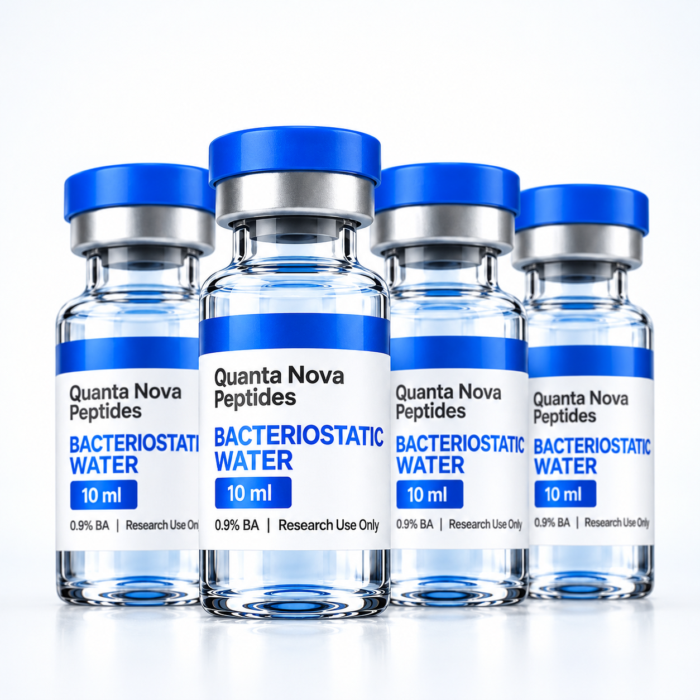
Explore Quanta Nova BAC Water 4-Pack
Quanta Nova BAC water: each batch is tested by an independent ISO/IEC 17025-accredited laboratory, and reports are published by lot number.
View BAC water & current COA Or compare all bacteriostatic water (BAC water) sizes, from 4-packs to bulk cases.
Research-use note: Quanta Nova products are sold for laboratory research use only and are not intended for human or veterinary use. This guide does not provide dosing, preparation, or administration instructions for any specific compound.
Sources: Solubility Guidelines for Peptides, Sigma-Aldrich; Antimicrobial Excipient-Induced Reversible Association of Therapeutic Peptides in Parenteral Formulations, Journal of Pharmaceutical Sciences; Interactions Between Peptide and Preservatives, Pharmaceutical Research (2015); Antimicrobial Preservatives for Protein and Peptide Formulations: An Overview, Stroppel et al., Pharmaceutics (2023); A2LA Directory of Accredited Organizations.