Resources / Peptide science
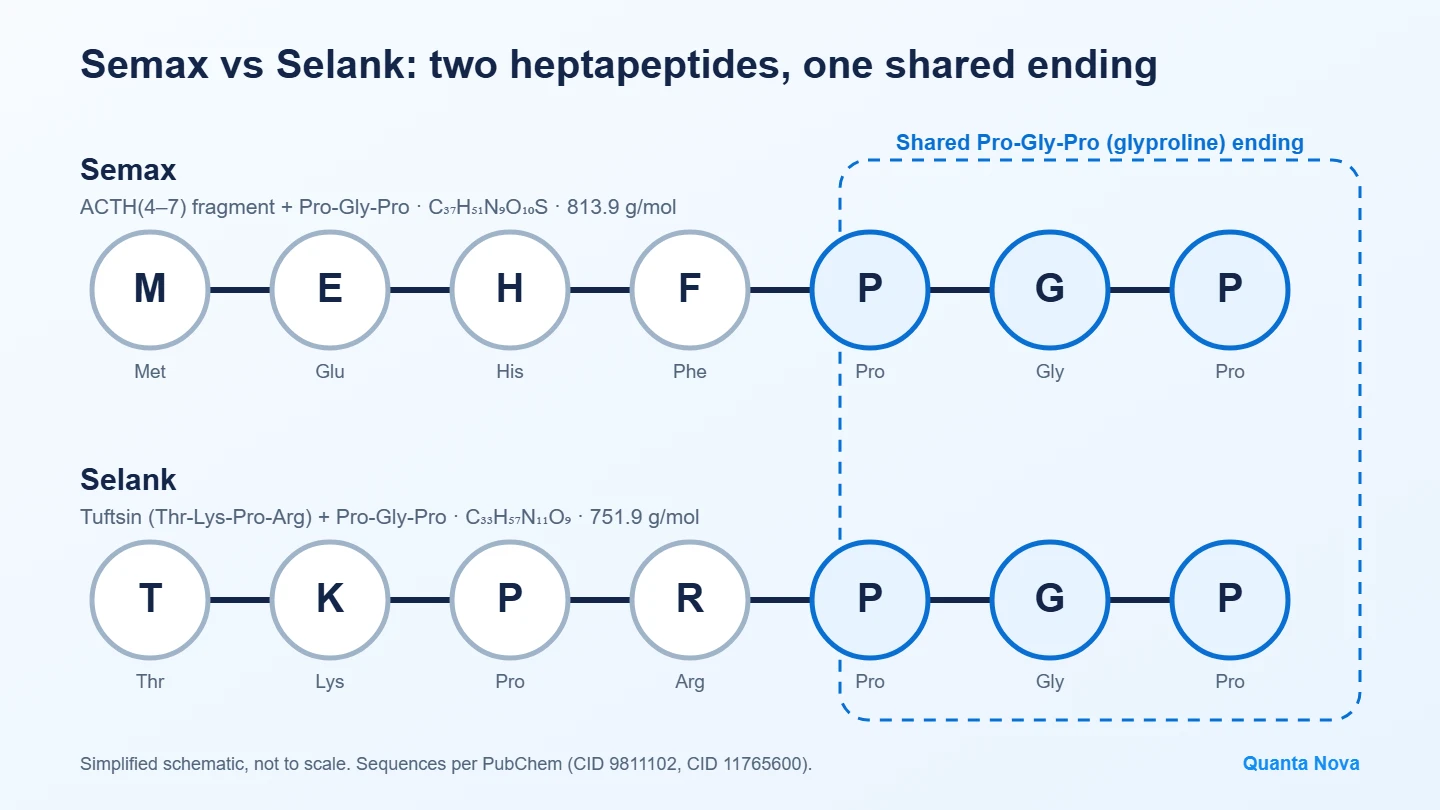
Semax and Selank share three of their seven amino acids. Their different beginnings help explain why Semax attracts research on neuronal support, while Selank is studied for stress-related signaling. But how much do those findings actually tell us?
The answer starts with their different molecular origins—and becomes clearer when we separate what an experiment measured from what people hope it might mean.

The key difference: Semax is an ACTH-derived peptide studied for neurotrophic signaling, learning-related endpoints and experimental brain injury. Selank is a tuftsin-derived peptide studied for GABA-related signaling and stress-related behavior. These are overlapping research areas, not established benefits of Quanta Nova products or proof that either peptide is better. [1] [2] [3] [5]
In this guide
The essential comparison
Semax vs Selank at a glance
| Feature | Semax | Selank |
|---|---|---|
| Molecular starting point | ACTH fragment: Met–Glu–His–Phe | Tuftsin: Thr–Lys–Pro–Arg |
| Full sequence | Met–Glu–His–Phe–Pro–Gly–Pro MEHFPGP |
Thr–Lys–Pro–Arg–Pro–Gly–Pro TKPRPGP |
| Shared feature | Seven amino acids; Pro–Gly–Pro ending | Seven amino acids; Pro–Gly–Pro ending |
| Selected research emphasis | BDNF signaling, learning tasks and gene activity in brain-ischemia models | GABA-related signaling, anxiety-like behavior and stress models |
| Molecular weight* | Approximately 813.9 g/mol | Approximately 751.9 g/mol |
| Evidence to interpret | Preclinical experiments and limited human reports | Preclinical experiments and limited human reports |
| Interchangeable? | No. Different sequences mean different research compounds. | |
*Values refer to the parent molecules, not every salt or formulation. Compound identifiers: PubChem CID 9811102 (Semax) and 11765600 (Selank). Research examples are discussed below. [1] [2]
Similar design, different biological starting points
A peptide is a short chain of amino acids. Their order matters: changing the sequence can change how the molecule interacts with enzymes and other biological systems.
Semax begins with a fragment of adrenocorticotropic hormone (ACTH). Selank begins with tuftsin, a naturally occurring peptide associated with immune regulation. Both have an added Pro–Gly–Pro ending, a design discussed in the literature in relation to resistance to enzymatic breakdown. Sharing that ending does not make them versions of the same molecule. [1] [2] [4]
Semax · neuronal support pathways
What is Semax being studied for?
Semax research often focuses on brain-derived neurotrophic factor (BDNF), a protein that helps nerve cells survive and supports their ability to adapt. BDNF helps regulate changes at synapses—the connections through which neurons communicate. This adaptability, known as synaptic plasticity, is important for learning and memory. [6]
That role helps explain why researchers examine BDNF signaling when studying Semax. In a 2006 rat study, Semax increased BDNF protein levels and signaling through its receptor, TrkB, in the hippocampus, a brain region important to memory. The rats also showed more learned avoidance responses during a behavioral task, giving researchers a finding to investigate alongside the molecular changes. Together, these results provide a basis for further studies of learning-related function. [3]
This interest in neuronal support also extends to how brain tissue responds to injury. In a separate rat study of ischemia—an interruption of blood supply that deprives tissue of oxygen—Semax changed the activity of genes associated with immune and blood-vessel-related responses. These findings give researchers measurable biological processes to follow in studies of the brain’s response to injury. [7]
Why this research matters: these findings give researchers a foundation for exploring Semax’s potential to support learning-related function and neuronal resilience. Well-controlled human studies can build on this work by testing whether the observed biological changes translate into meaningful benefits for people.
Selank · stress-related signaling
What is Selank being studied for?
Selank research often centers on GABA, a major inhibitory messenger in the mature brain. GABA generally makes nerve cells less likely to fire, helping keep neural activity balanced. Its role in regulating this activity makes GABA-related signaling an important area of research into stress and anxiety. [8]
Researchers have explored Selank’s relationship with this balancing system by measuring the activity of genes involved in nerve-cell communication. In a 2016 rat study, Selank and GABA produced some similar gene-expression response patterns in the frontal cortex. The authors proposed that Selank may modulate the GABAergic system, providing a starting point for further investigation of how the peptide may influence neural signaling. [5]
Cell studies offer another way to examine the same signaling question, allowing researchers to compare responses to specific compounds in a defined setting. In a 2017 study using IMR-32 human neuroblastoma cells, Selank alone did not change the measured gene-expression levels, while responses differed when it was combined with GABA or olanzapine. Comparing these results with the rat findings helps researchers refine their hypotheses about which responses may depend on the cell type and experimental conditions. [9]
Why this research matters: these studies provide starting points for understanding how Selank may influence stress-related signaling and for investigating potential calming effects. Larger, well-controlled human studies can build on this work by testing whether the observed biological changes translate into meaningful benefits for people and how Selank compares with established treatments.
Visual guide
Semax and Selank: brain pathways explained
The biology behind these findings is easier to follow at two scales: the brain regions researchers studied and the connections between individual nerve cells. A neuron is a nerve cell; synapses are the connections where cells communicate. [6] The illustrations below bring those perspectives together.
Supporting adaptable neural connections

Normal role in humans: BDNF helps neurons survive and supports the ability of synapses to adapt. That adaptability, called plasticity, is important for learning and memory. [6]
Observed in rats: Semax increased BDNF protein levels and signaling through its receptor, TrkB, in the hippocampus. [3]
Potential benefit being investigated: support for learning-related function and neuronal resilience. Whether these signals translate into meaningful human benefits remains a research question.
Understanding the balance of neural activity
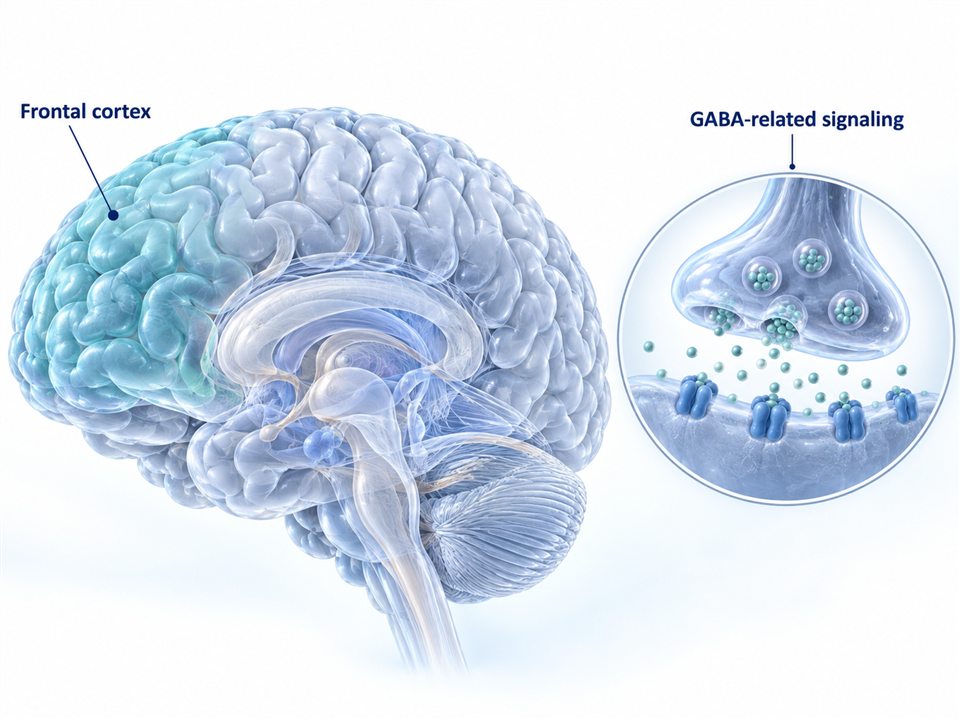
Normal role in humans: GABA is an inhibitory messenger that generally makes neurons less likely to fire. This helps balance activity in the nervous system. [8]
Observed in rats: Selank changed neurotransmission-related gene expression in the frontal cortex; the authors proposed possible modulation of the GABAergic system. [5]
Potential benefit being investigated: modulation of stress-related responses and possible calming effects. Human studies can help establish their clinical relevance.
Conceptual illustrations with human anatomy for orientation. Highlights show selected rat-study sites, not measured human activation or exclusive peptide targets. Clinical benefits remain under investigation.
Direct comparisons
What happens when researchers test both?
Studies that include both peptides help separate shared responses from peptide-specific findings. The examples below answer two different questions: did behavior change in a rat model, and did the relationship between brain-activity signals change in people?
Semax and Selank: what changed in the rat study?
View larger illustration ↗
Why test both peptides?
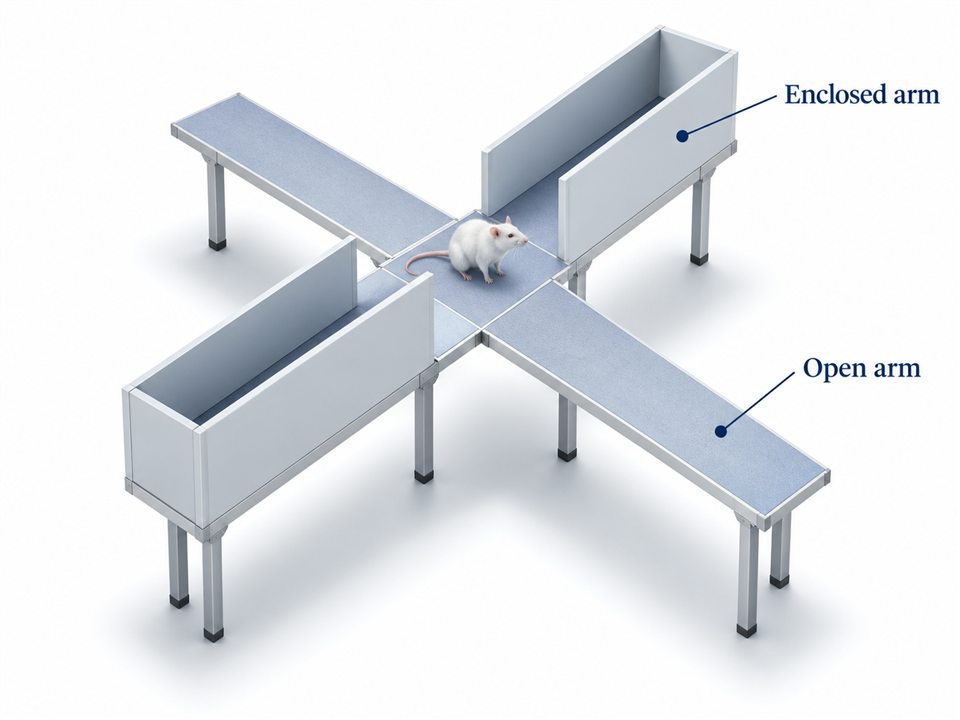
The study examined behavior after damage to dopamine-producing neurons, using a rat model of Parkinson-like changes. Testing Semax and Selank in the same model helps researchers examine whether their behavioral responses overlap or differ. [10]
The maze helps separate exploration of exposed areas—an indirect measure of anxiety-like behavior—from changes in how much an animal moves. [16]
What did Semax and Selank each do?
- Semax: no change in motor activity or passive defensive behavior was reported. The abstract does not report an anxiety-reducing effect for Semax.
- Selank: anxiety-like behavior decreased in the maze, while motor activity and passive defensive behavior remained unchanged. [10]
What the comparison adds: the anxiety-related finding is attributed to Selank, while unchanged movement was a shared finding. Selank’s response therefore occurred without an overall increase in activity, helping researchers distinguish an anxiety-related signal from simply moving more.
Shared and distinct responses in a human brain network
View larger illustration ↗
Scan timing: Semax, Selank and placebo comparison [11]
- Beforeexposure
- 5 minutesafter exposure
- 20 minutesafter exposure
How the comparison worked
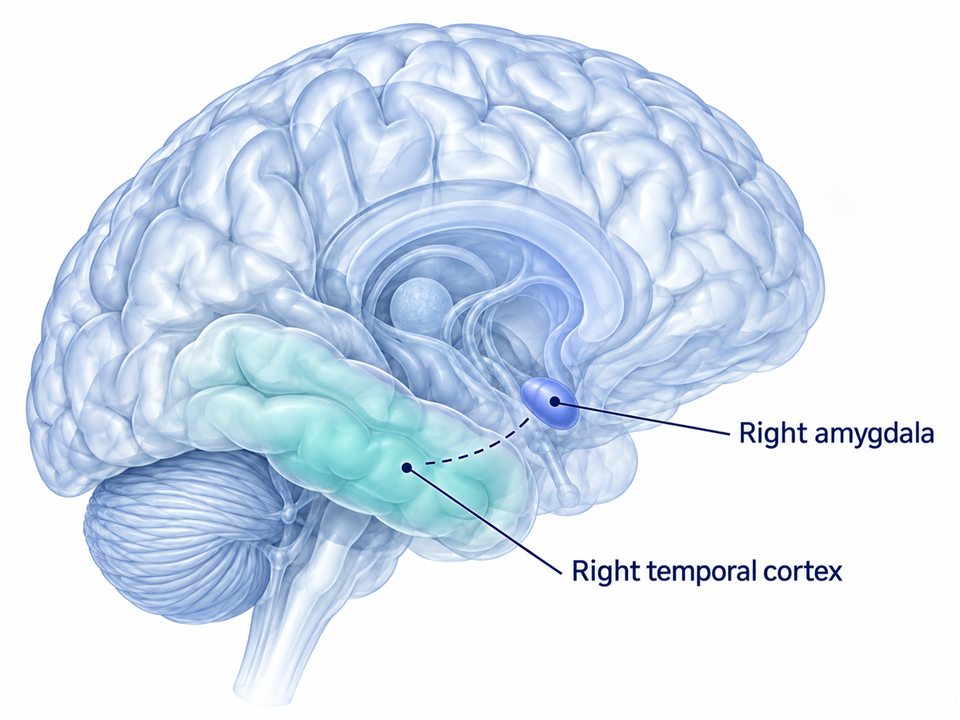
Researchers compared Semax, Selank and placebo using resting-state fMRI, with scans collected before exposure and again 5 and 20 minutes afterward. The study examined functional connectivity: relationships between activity-related signals from different brain regions. [11]
fMRI tracks blood-oxygen-level-dependent signals. Connectivity analysis asks how closely those signals fluctuate together over time; it does not directly count firing neurons or show new nerve connections forming. [17]
What researchers found
- Where: differences involved the right amygdala and parts of the right temporal cortex. The amygdala participates in regulating anxiety.
- How the peptides compared: some responses were shared by Semax and Selank, while others were peptide-specific. [11]
Why this is useful: the findings give researchers candidate brain-network responses to investigate when comparing the peptides. A different connectivity pattern is not automatically better or worse; its value depends on how it relates to meaningful outcomes.
Research takeaway: pairing imaging with direct measures of anxiety symptoms, memory or everyday functioning could help establish whether these short-term biological responses have practical benefits. The imaging findings give that follow-up work specific brain-network responses to examine.
Drawing the findings together
Semax vs Selank: what the findings mean
The comparisons above help explain why Semax and Selank attract different research interests. Semax has been investigated in learning and neuronal-adaptation models; Selank in stress-related signaling and behavior. Their responses can overlap, but the two peptides are distinct research compounds.
Semax
Learning and neuronal adaptation
- Measured in rats
- Increased BDNF-related signaling alongside changes in a learned behavioral response. [3]
- The research question
- How might the peptide influence the processes that help nerve-cell connections adapt and support learning?
Selank
Stress-related signaling and behavior
What should you check before buying Semax or Selank for research?
Choose a supplier that makes it easy to confirm what you are buying and review the batch results before ordering. For Semax and Selank, the most useful details are the exact peptide, the measured amount and a certificate of analysis (COA) you can verify.
- Confirm the exact peptide. Check the name, sequence and chemical form against your research protocol. Standard Semax, an N-acetyl analog and a multi-peptide blend are different research materials.
- Check purity and measured quantity. A high chromatographic purity percentage does not, by itself, confirm how much peptide is in a vial. For powder, look for measured peptide content; for a liquid, look for measured concentration in mg/mL.
- Look for finished-batch testing. Check whether the report describes the product being sold or only its starting material. Review the actual test results, including bacterial endotoxins where reported, rather than relying on a “lab tested” badge alone.
- Verify the COA independently. Look for a batch number, test date, laboratory name and report number. Where a laboratory verification link is provided, use it to compare the displayed results with the laboratory’s own record. Confirm that the documentation applies to the batch supplied.
- Review formulation and storage. Check the liquid’s ingredients and concentration, or the powder’s labeled amount per vial. Confirm the storage instructions for that exact format so it fits your laboratory’s handling requirements.
Semax vs Selank: common questions
Differences and research findings
Is Selank the same as Semax?
No. Semax and Selank are different synthetic peptides. Both contain seven amino acids and share a Pro–Gly–Pro ending, but their first four amino acids differ. Semax is derived from an ACTH fragment; Selank is derived from tuftsin. Their different structures help explain why they are investigated for different biological responses. [1] [2] [4]
Is Semax stronger than Selank, or which is better?
Neither has been established as clinically better overall in the evidence reviewed here. In one laboratory assay of human-serum enzymes, Semax inhibited enkephalin breakdown at half the concentration required for Selank: IC50 values were 10 µM and 20 µM, respectively. IC50 is the concentration needed to reduce the measured enzyme activity by half. That makes Semax more potent for this specific laboratory endpoint; it does not establish twice the benefit in people. For research, the useful choice depends on the biological question and outcome being measured. [18]
What potential benefits are Semax and Selank being studied for?
Semax research explores learning, neuronal adaptation and responses to brain injury, including BDNF-related signaling in animal models. Selank research explores stress-related behavior and GABA-associated signaling; a small patient study also reported anti-anxiety effects. These findings help explain the scientific interest in both peptides. Animal responses, molecular changes and small clinical reports answer different questions, so none should be presented as a guaranteed benefit of a research product. [3] [5] [7] [12]
Formulations, mixing and storage
Can Semax and Selank be mixed in one solution?
A combined solution may be possible, but confirming that both peptides remain stable is essential. We have not identified published stability data validating a Semax–Selank mixture, so the exact formulation would need testing.
Quanta Nova supplies Semax and Selank separately, giving researchers clearly defined starting materials with individual batch documentation. Each product page includes specifications and its COA to support informed laboratory research.
What is the difference between peptide spray and lyophilized powder?
A liquid spray contains a formulated peptide solution; lyophilized powder is freeze-dried material that requires a suitable solvent for laboratory work. Quanta Nova offers Semax (C-Max) and Selank liquid sprays, each labeled 30 mL at 2 mg/mL, and Selank lyophilized powder as four 10 mg vials. Formulation, excipients, concentration and handling requirements matter when matching a material to a research protocol. Compare the product specifications and displayed COAs.
How should Semax and Selank be stored?
Follow the instructions for the exact formulation. Quanta Nova’s Semax (C-Max) and Selank liquid sprays should be refrigerated at 2–8 °C, protected from light, and not frozen. The Selank lyophilized 10 mg vials should be stored at −20 °C, dry and protected from light. Once powder is reconstituted, storage requirements depend on the resulting solution and the laboratory protocol. Review the current product-page storage instructions before ordering or handling a material.
FDA status and safety
Are Semax and Selank FDA approved?
No. Neither Semax nor Selank is an FDA-approved drug. FDA review for pharmacy compounding is separate from approval of a finished medicine, and an advisory committee recommendation does not grant drug approval. Quanta Nova supplies the materials linked here for laboratory research only. [13] [14] [15]
Are Selank and Semax safe, and what is known about side effects?
The available evidence does not establish a comprehensive human safety profile for either peptide. FDA has identified gaps in human safety information and potential immune-response risks associated with peptide aggregation and impurities in compounded preparations. A COA helps researchers assess the tests reported for a batch; it does not establish safety for human use or capture every possible side effect. [13] [15]
Formulation and storage details refer to the Quanta Nova products linked below. Product and regulatory information checked October 25, 2026.
Specifications & batch documentation
Explore Semax and Selank research materials
View the product, review its specifications and open the displayed certificate of analysis (COA)—all on the same product page.
Liquid formulation
Selank Liquid Spray
30 mL · Labeled 2 mg/mL
Formulation details and batch COA.
Liquid formulation
Semax Liquid Spray (C-Max)
30 mL · Labeled 2 mg/mL
Formulation details and batch COA.
Lyophilized powder
Selank 10 mg 4-Pack
10 mg per vial · Four vials
Specifications and batch COA.
For laboratory research only. Not for human consumption or administration.
Sources and research references
This is a focused educational comparison, not a systematic review. Sources below identify the experimental model; findings are limited to the material, conditions and endpoints studied. Primary studies, public compound records and FDA documents were checked for this revision.
- PubChem. Semax, CID 9811102.Compound reference: sequence and molecular identity.
- PubChem. Selank, CID 11765600.Compound reference: sequence and molecular identity.
- Dolotov OV et al. Semax regulates BDNF and trkB expression in the rat hippocampus. Brain Research. 2006;1117:54–60.Primary animal study. DOI: 10.1016/j.brainres.2006.07.108.
- Ashmarin IP et al. Natural and hybrid (“chimeric”) stable regulatory glyproline peptides. Pathophysiology. 2005;11:179–185.Review: peptide origins and glyproline design.
- Volkova A et al. Selank administration affects the expression of some genes involved in GABAergic neurotransmission. Frontiers in Pharmacology. 2016;7:31.Primary rat study; its introduction documents Selank’s development and its acknowledgments name Russian Science Foundation support. DOI: 10.3389/fphar.2016.00031.
- National Library of Medicine. BDNF gene. MedlinePlus Genetics.Background reference: neuronal survival and synaptic plasticity.
- Medvedeva EV et al. The peptide semax affects the expression of genes related to the immune and vascular systems in rat brain focal ischemia. BMC Genomics. 2014;15:228.Primary animal study; its acknowledgements document Russian research grants and institutional programs. DOI: 10.1186/1471-2164-15-228.
- de Leon AS, Tadi P. Biochemistry, Gamma Aminobutyric Acid. StatPearls / NCBI Bookshelf.Background reference: GABA signaling.
- Filatova E et al. GABA, Selank, and Olanzapine affect the expression of genes involved in GABAergic neurotransmission in IMR-32 cells. Frontiers in Pharmacology. 2017;8:89.Primary cell-culture study; Selank-alone result distinguished from combination findings.
- Slominsky PA et al. Peptides semax and selank affect the behavior of rats with 6-OHDA induced PD-like parkinsonism. Doklady Biological Sciences. 2017;474:106–109.Primary animal comparison. DOI: 10.1134/S0012496617030048.
- Panikratova YR et al. Functional connectomic approach to studying Selank and Semax effects. Doklady Biological Sciences. 2020;490:9–11.Exploratory human imaging, 52 participants. DOI: 10.1134/S001249662001007X.
- Zozulia AA et al. Efficacy and possible mechanisms of action of a new peptide anxiolytic selank in generalized anxiety disorders and neurasthenia. 2008;108(4):38–48.Russian-language human clinical report; English abstract reviewed.
- FDA. Briefing document: Semax-related bulk drug substances. Pharmacy Compounding Advisory Committee, July 23–24, 2026.Regulatory evidence and safety review; staff assessment is distinct from an advisory vote or drug approval.
- FDA. July 23–24, 2026 meeting of the Pharmacy Compounding Advisory Committee.Official meeting scope and explanation of non-binding advisory recommendations.
- FDA. Certain bulk drug substances for use in compounding that may present significant safety risks.Official safety information: Selank acetate (TP-7) entry.
- Walf AA, Frye CA. The use of the elevated plus maze as an assay of anxiety-related behavior in rodents. Nature Protocols. 2007;2:322–328.Research-method reference explaining open-arm exploration and anxiety-like behavior. DOI: 10.1038/nprot.2007.44.
- National Institute of Mental Health, AFNI. Correlation analysis (functional connectivity).Methods reference: similarity of blood-oxygen-level-dependent signals and the limits of interpreting connectivity.
- Kost NV et al. Semax and selank inhibit the enkephalin-degrading enzymes from human serum. Bioorg Khim. 2001;27(3):180–183.Primary in vitro enzyme assay using human serum, not a clinical comparison. Reported IC50: Semax 10 µM; Selank 20 µM. DOI: 10.1023/A:1011373002885.