
50 mg × 4 Vials
Vanguard Tested
Made in USA
Third-Party
Tested
Fast & Reliable
Shipping
Secure Checkout
Your data is safe
Satisfaction
Guaranteed
GHK-Cu Copper Peptide 50 mg
In Stock
4 Vials · Lyophilized Powder · Made in USA
$99.00
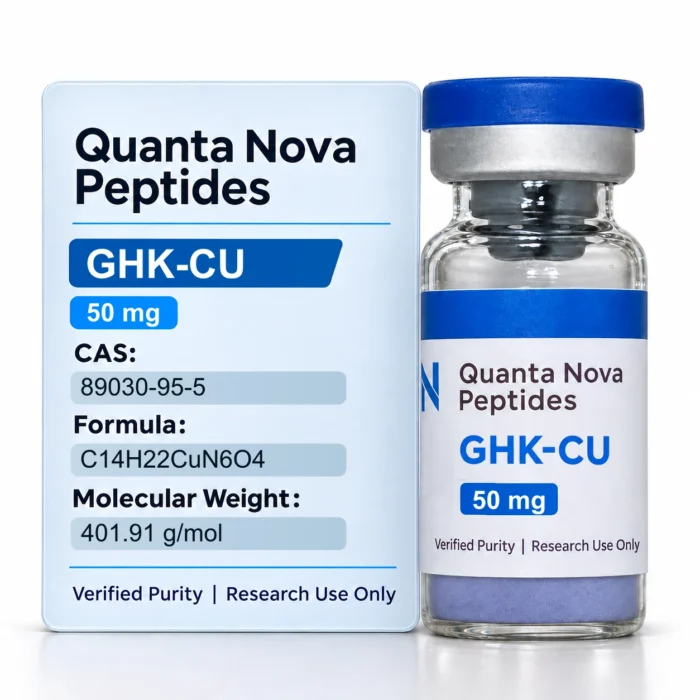
GHK-Cu (glycyl-L-histidyl-L-lysine copper complex) is a naturally occurring copper-binding peptide widely used in laboratory research. Each pack contains four vials of 50 mg lyophilized powder. Intended for laboratory research use.
- 50 mg per vial × 4 vials, lyophilized powder
- Third-party tested by an ISO/IEC 17025-accredited laboratory: identity, purity, quantity and endotoxins on every batch
- Lyophilized in the USA; PES micron-filtered before lyophilization
50 mg × 4 Vials
Lyophilized powder
Vanguard Tested
Third-party COA every batch
Made in USA
Lyophilized in-house
For Laboratory Research Use Only · Not for Human Use
COA Report
Certificate of Analysis
Batch No.
LP-002-260810-A
Date
2026-08-10
Vanguard Report No.
V260822-8 001
Identity
Pass - Matches Ref. Standard
Purity
>99.80% + 0.18%
Quantity
53.18 mg
Endotoxins
Pass
Batch Summary
This batch has been independently tested, verified, and documentation is available for review.
Description
Want to combine GHK-Cu with other peptides? Build your own 4-pack or 8-pack peptide bundle and choose any mix of separate vials.
Prepared by Quanta Nova LLC · Technical review by Isaiah D., Chief Technology Officer and Head of Formulations, Quantum Innovation Labs LLC · Updated October 2026
GHK-Cu 50 mg 4-Pack: Product Overview
Quanta Nova GHK-Cu, also known as copper tripeptide-1 or copper peptide GHK-Cu, is supplied as 50 mg of lyophilized powder per vial, four vials per pack. GHK-Cu is the copper(II) complex of the tripeptide glycyl-L-histidyl-L-lysine, a compound widely used in laboratory studies of copper-binding chemistry, extracellular-matrix models and cellular pathways. It is intended for laboratory research use.
Each batch is lyophilized in our U.S. facility. The solution is passed through PES micron filtration before lyophilization to remove particulates, and the lyophilization process is controlled and monitored for batch-to-batch consistency.
Why lyophilized? Lyophilization removes water from the peptide, which keeps GHK-Cu stable at room temperature during shipping and allows long-term storage at −20 °C. Each vial contains a dry blue powder that dissolves readily in bacteriostatic or sterile water (see the reconstitution reference below).
GHK-Cu Specifications
| Parameter | Specification |
|---|---|
| Compound | GHK-Cu (copper tripeptide; glycyl-L-histidyl-L-lysine copper(II) complex) |
| Sequence | Gly-His-Lys · Cu(II) |
| Molecular formula | C14H22N6O4Cu |
| Molecular weight | 401.91 g/mol |
| CAS number | 89030-95-5 |
| PubChem CID | 10111685 |
| UNII (FDA substance ID) | 6BJQ43T1I9 |
| Mass | 401.0999 Da |
| InChIKey | QMIFIFIYYPUVNU-ACMTZBLWSA-L |
| Parent peptide | GHK (C14H24N6O4, 340.38 g/mol, CAS 49557-75-7) |
| Solubility | Water-soluble |
| Form | Lyophilized powder (blue to blue-violet) |
| Amount | 50 mg per vial × 4 vials |
| Purity | Verified for every batch by HPLC (see current COA) |
| Storage (lyophilized) | −20 °C, dry, protected from light |
| Origin | Lyophilized in the USA |
Certificate of Analysis & Batch Verification
Every batch of GHK-Cu is independently tested by an ISO/IEC 17025-accredited laboratory, an ISO-accredited third-party laboratory in the United States, for:
- Identity: confirmed against a reference standard (HPLC-UV/VIS)
- Purity: chromatographic purity (HPLC-UV/VIS)
- Quantity: measured peptide content per vial
- Endotoxins: bacterial endotoxin testing (LAL)
Results for the batch currently shipping are shown in the COA Report section on this page and update automatically when a new batch is released. The Verify this COA button opens the lab’s own record for that batch, and all current and previous reports are listed on our COA Reports page.
Laboratory Reconstitution Reference
GHK-Cu is water-soluble. In laboratory settings, lyophilized GHK-Cu is commonly reconstituted with bacteriostatic water (BAC water) or sterile water, depending on the protocol. Using the labeled 50 mg amount, the calculated concentration depends on the volume of diluent added:
| Diluent added to 50 mg | Calculated concentration (nominal 50 mg) |
|---|---|
| 1.0 mL | 50 mg/mL |
| 1.5 mL | 33.3 mg/mL |
| 2.0 mL | 25 mg/mL |
| 2.5 mL | 20 mg/mL |
| 3.0 mL | 16.7 mg/mL |
Formula: concentration (mg/mL) = 50 mg ÷ volume of diluent (mL). Our vials hold up to 3 mL, so 3.0 mL is the maximum volume.
Laboratory handling notes: allow the vial to reach room temperature, add the diluent slowly down the inside wall of the vial, and swirl gently until dissolved. Do not shake. A clear blue solution is normal; the color comes from the copper(II) complex. Choosing a diluent? See our guides to what bacteriostatic water is and bacteriostatic vs. sterile water.
For our product-specific observations, see the GHK-Cu entry in our BAC water for peptides compatibility checklist. A clear solution alone does not establish peptide integrity or stability.
Storage & Handling
- Lyophilized: store at −20 °C, dry and protected from light. Short periods at room temperature during shipping are expected for lyophilized peptides.
- After reconstitution: refrigerate at 2–8 °C, protect from light and use within 14–30 days, following your laboratory’s protocol.
- Avoid repeated freeze-thaw cycles. Handle with standard laboratory protective equipment.
Research Background
GHK (glycyl-L-histidyl-L-lysine) was first isolated from human plasma in 1973 and has a strong affinity for copper(II) ions, forming the GHK-Cu complex [1]. Since then it has been examined in published in vitro and animal studies, including work on copper transport, extracellular-matrix and collagen synthesis in fibroblast cultures, and tissue-remodeling models [2]. More recent gene-expression analyses have examined how GHK relates to the expression of large groups of human genes in cell-based datasets [3][4]. For a plain-language overview of the compound, see our guide What Is GHK-Cu? The Copper Peptide Explained.
Areas of laboratory investigation include:
- Copper-binding and copper-transport chemistry
- Fibroblast and extracellular-matrix models
- Gene-expression and cellular-pathway studies
- Oxidative-stress models
These findings come from preclinical research. GHK-Cu is not approved by the FDA as a drug, and this product is not intended to diagnose, treat, cure or prevent any disease.
GHK-Cu 50 mg: Frequently Asked Questions
What is GHK-Cu?
GHK-Cu is a copper peptide: the tripeptide glycine-histidine-lysine bound to a copper(II) ion. It is a naturally occurring complex first identified in human plasma and is sold here as a lyophilized research compound.
What is the difference between GHK and GHK-Cu?
GHK is the tripeptide glycyl-L-histidyl-L-lysine on its own (C14H24N6O4, 340.38 g/mol, CAS 49557-75-7). GHK-Cu is the same peptide bound to a copper(II) ion (C14H22CuN6O4, 401.91 g/mol, CAS 89030-95-5). The copper complex gives GHK-Cu its blue color. This product is GHK-Cu.
What is the CAS number of GHK-Cu?
The CAS number of GHK-Cu is 89030-95-5. Other identifiers include PubChem CID 10111685 and FDA UNII 6BJQ43T1I9. The parent peptide GHK (without copper) is CAS 49557-75-7.
What is GHK-Cu 50 mg used for in research?
Laboratories use GHK-Cu in studies of copper-binding chemistry, fibroblast and extracellular-matrix models, gene-expression and oxidative-stress research. It is sold strictly for in vitro and laboratory research.
How is this GHK-Cu supplied?
As 50 mg of lyophilized powder in each of four sealed glass vials, lyophilized in the USA and tested batch by batch by an ISO/IEC 17025-accredited laboratory.
How much bacteriostatic water is used to reconstitute 50 mg of GHK-Cu?
It depends on the concentration your protocol requires. For example, 2 mL gives 25 mg/mL and 3 mL (the vial maximum) gives 16.7 mg/mL. See the reconstitution reference table above for common volumes.
Why does reconstituted GHK-Cu look blue?
The blue color comes from the copper(II) ion bound to the peptide. A clear blue solution is expected; cloudiness or particles are not.
How should GHK-Cu be stored?
Store lyophilized vials at −20 °C, dry and away from light. After reconstitution, refrigerate at 2–8 °C and follow your laboratory’s protocol for use-by times.
How is each batch tested, and can I verify it?
Every batch is tested by an ISO/IEC 17025-accredited laboratory for identity, purity, quantity and endotoxins. The current certificate and a Verify this COA link are on this page, and all reports are listed on our COA Reports page.
Is GHK-Cu FDA approved?
No. GHK-Cu is not approved by the FDA as a drug. Quanta Nova GHK-Cu is sold for laboratory research only and is not for human or veterinary use.
References
- Pickart L, Thaler MM. Tripeptide in human serum which prolongs survival of normal liver cells and stimulates growth in neoplastic liver. Nature New Biology. 1973;243(124):85–87. PubMed
- Pickart L. The human tri-peptide GHK and tissue remodeling. J Biomater Sci Polym Ed. 2008;19(8):969–988. PubMed
- Pickart L, Vasquez-Soltero JM, Margolina A. GHK peptide as a natural modulator of multiple cellular pathways in skin regeneration. BioMed Research International. 2015;2015:648108. PMC
- Pickart L, Margolina A. Regenerative and protective actions of the GHK-Cu peptide in the light of the new gene data. Int J Mol Sci. 2018;19(7):1987. PMC
Research Use Only
This product is intended for laboratory research use only by qualified professionals. It is not a drug, food, cosmetic or dietary supplement, is not for human or veterinary use, and has not been evaluated by the FDA. Information on this page is provided for research and educational purposes only.