A clear guide to what BAC water contains, how it differs from other laboratory solutions, and how to evaluate the evidence for a specific batch.
Prepared by Quanta Nova LLC · Technical review by Isaiah D., Chief Technology Officer and Head of Formulations, Quantum Innovation Labs LLC.
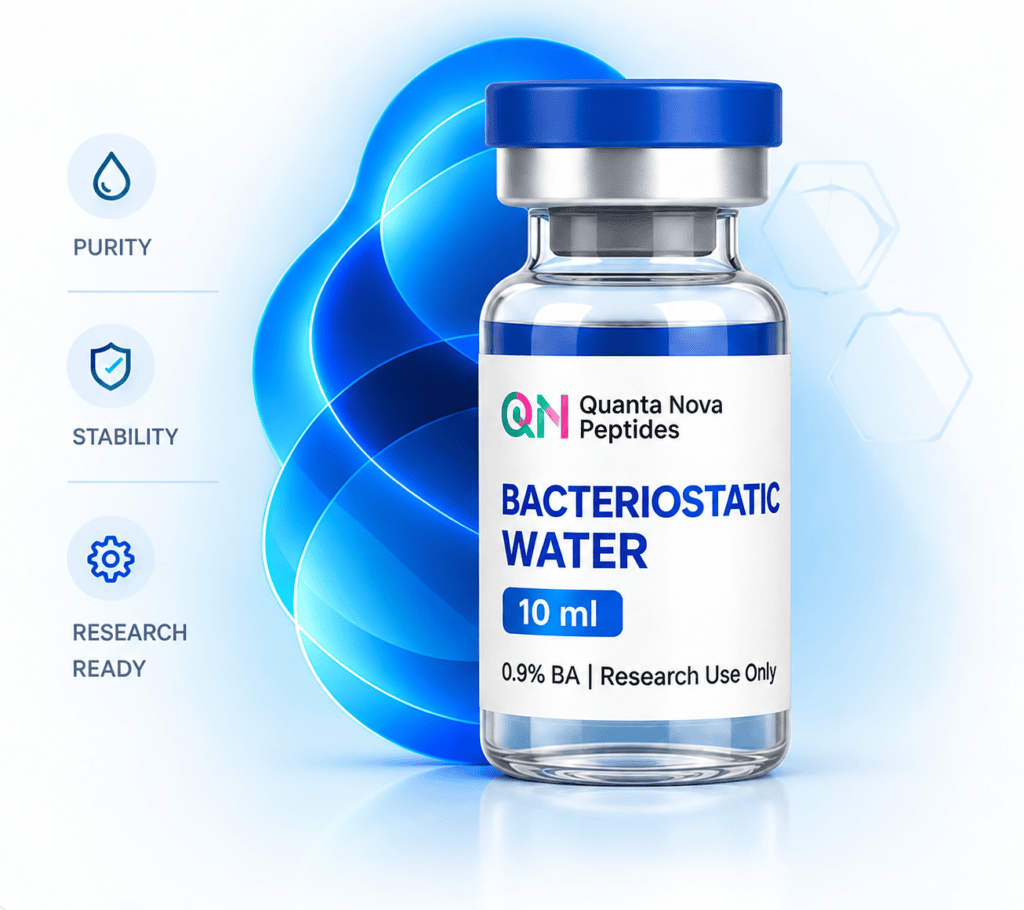
Bacteriostatic water is water formulated with a preservative that inhibits the growth of certain bacteria. BAC water is simply the common shortened name—not a different product. Quanta Nova’s research BAC water is formulated with benzyl alcohol at a labeled concentration of 0.9%.
That definition is useful, but it does not answer every quality question. Whether a product is appropriate for a particular laboratory protocol depends on its formulation, the material being studied, and the results documented for the batch.
BAC water and bacteriostatic water are the same term. The preservative distinguishes it from preservative-free sterile water; a batch COA shows which quality attributes were actually tested.
What does “bacteriostatic” mean?
Bacteriostatic means that a substance inhibits bacterial growth. In BAC water, benzyl alcohol serves as the preservative. It does not make contaminated liquid safe, replace appropriate laboratory handling, or establish that every vial is sterile. Sterility is a separate quality attribute, assessed through its own controls and, when performed, a separate test.
The familiar 0.9% figure describes Quanta Nova’s labeled formulation. Other bacteriostatic-water products can have different specifications, so the label and current batch documentation matter more than the shorthand name.
BAC water versus preservative-free sterile water
Bacteriostatic water
Contains a bacteriostatic agent, commonly benzyl alcohol. Check the product label for its formulation and the COA for batch-level test results.
Preservative-free sterile water
Does not contain benzyl alcohol. Its suitability, handling, and container-use instructions depend on the particular product—not on the word “sterile” alone.
These terms describe different properties: “bacteriostatic” concerns preservative action; “sterile” concerns microorganisms. One is not proof of the other.
What about research peptides?
BAC water is used as a diluent in some laboratory workflows involving lyophilized research compounds. Benzyl alcohol does not automatically damage every peptide, but no single diluent is suitable for every peptide or formulation. Solubility and stability can depend on the compound’s sequence and other formulation conditions, including pH, concentration, and additional ingredients.
In a published peptide-formulation study, the effects of antimicrobial preservatives differed among the peptides examined. That is a reason to follow a compound-specific research protocol—not to infer universal compatibility or incompatibility from the presence of benzyl alcohol.
What does a BAC-water COA actually tell you?
A certificate of analysis (COA) identifies a batch and records the tests performed on the submitted sample. A BAC-water report may include benzyl alcohol content, pH, sterility, or bacterial-endotoxin testing; the test panel varies. Read the report for what it actually tests. The listed tests, results, and acceptance criteria show how the sample performed for those particular quality attributes. An unlisted result should not be assumed.
A supplier-provided PDF is useful, but you can take verification further when the issuing laboratory makes a report searchable. For Quanta Nova BAC water, start with the current COA on the BAC water hub. Then compare the batch number on your product with the report number, laboratory, date, tests, results, and stated criteria.
How to verify the evidence
Match the batch
Compare the product’s batch number with the COA.
Read the tests
Check the test names, results, and acceptance criteria.
Check the source
When available, compare the report with the issuing lab’s public record.
If a Quanta Nova report names Vanguard Laboratory, its report number can be checked in Vanguard’s public search. A matching lab record helps authenticate the report; it does not add unlisted tests or guarantee the condition of every vial.
The takeaway
BAC water is bacteriostatic water. Understanding it begins with the preservative, but evaluating a specific product also means checking its intended use, formulation, and current batch evidence. For research involving a particular compound, suitability should be determined from that compound’s requirements and the laboratory protocol—not from a blanket claim about BAC water.
View the research product details and the COA currently displayed for its batch.
View BAC water & current COA Or compare all bacteriostatic water (BAC water) sizes, from 4-packs to bulk cases.
Research-use note: Quanta Nova BAC water is offered for laboratory research only and is not intended for human or animal use.
Sources: DailyMed bacteriostatic-water label (formulation context; not a claim about Quanta Nova’s regulatory status); D’Addio et al., Journal of Pharmaceutical Sciences (2021) (peptide–preservative interaction study); Vanguard Laboratory (public report verification).